Data Science & Machine Learning Engineering Training
Data science is transforming industries through predictive modeling and automated intelligence. Our Ghaziabad training combines statistical rigor with production software practices, teaching you to extract insights, build ML models, and serve predictions via REST endpoints.
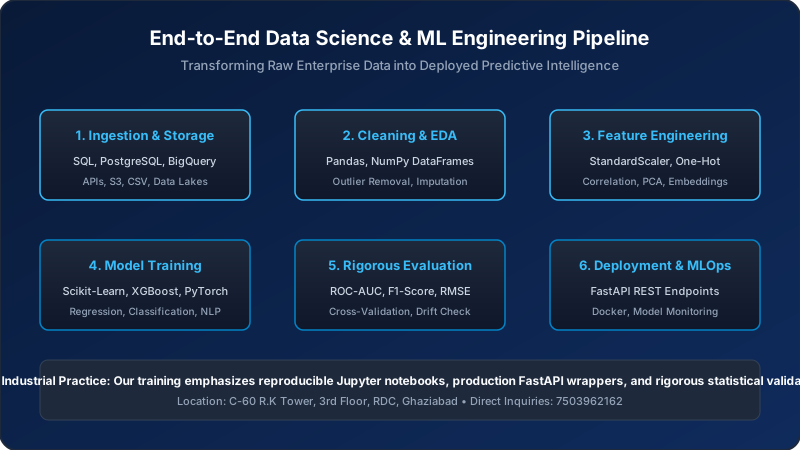
Why Learn This Technology?
Organizations rely on data scientists to optimize logistics, forecast revenue, personalize customer experiences, and detect fraud. High demand for skilled practitioners makes this one of the most rewarding tech disciplines.
Who Should Take This Course?
Graduates, analysts, software engineers, and domain specialists seeking data-driven decision making careers.
Course Prerequisites
Basic math (high school algebra/statistics). Prior coding experience is helpful but not mandatory.
Tools & Frameworks Covered
Career Opportunities & Outcomes
Graduates of this program are qualified for technical roles including:
- Data Scientist
- Machine Learning Engineer
- Data Analyst
- Business Intelligence Developer
Ghaziabad Training Center Location
Campus: C-60 R.K Tower, 3rd Floor, RDC, Ghaziabad
Inquiries: 7503962162
Get DirectionsComplete Course Syllabus
Structured modular learning path from foundational concepts to production-grade implementation.
Module 1: Applied Statistics & Exploratory Data Analysis (EDA)
Weeks 1-4- ✓ Descriptive statistics: Mean, median, mode, variance, standard deviation, and IQR
- ✓ Probability distributions: Normal, Binomial, Poisson, and Central Limit Theorem
- ✓ Hypothesis testing: p-values, t-tests, ANOVA, and Chi-Square tests
- ✓ NumPy vectorized computation: Arrays, broadcasting, indexing, and linear algebra
- ✓ Pandas DataFrames: Filtering, grouping, aggregation, merging, and pivot tables
- ✓ Data visualization: Matplotlib plots, Seaborn statistical charts, and storytelling
Module 2: Data Preprocessing, Cleaning & Feature Engineering
Weeks 5-8- ✓ Identifying and treating missing values: Imputation techniques (mean, KNN, iterative)
- ✓ Outlier detection: Z-score, Tukey boxplot fences, and robust scaling
- ✓ Categorical encoding: One-hot encoding, target encoding, and label encoding
- ✓ Feature scaling: StandardScaler, MinMaxScaler, and RobustScaler
- ✓ Dimensionality reduction: Principal Component Analysis (PCA) and t-SNE
- ✓ Handling imbalanced datasets: SMOTE, class weights, and stratified sampling
Module 3: Classical Machine Learning Algorithms
Weeks 9-14- ✓ Supervised learning: Linear Regression, Ordinary Least Squares, and Ridge/Lasso regularization
- ✓ Classification algorithms: Logistic Regression, Decision Trees, and Random Forests
- ✓ Gradient Boosting machines: XGBoost, LightGBM, and hyperparameter tuning (GridSearch, Optuna)
- ✓ Unsupervised learning: K-Means clustering, DBSCAN, and hierarchical clustering
- ✓ Model evaluation metrics: Precision, Recall, F1-Score, ROC-AUC curve, and Confusion Matrix
- ✓ Preventing overfitting: Bias-Variance tradeoff and k-fold cross validation
Module 4: Deep Learning Foundations & Production MLOps
Weeks 15-20- ✓ Artificial Neural Networks (ANN): Perceptrons, activation functions, and backpropagation
- ✓ Convolutional Neural Networks (CNN) for image classification fundamentals
- ✓ Natural Language Processing (NLP): Tokenization, TF-IDF, Word2Vec, and Transformers overview
- ✓ Model persistence: Serialization with Joblib and ONNX
- ✓ Serving predictions with FastAPI and Docker containerization
- ✓ Model monitoring: Data drift, concept drift, and production observability
Real-World Enterprise Projects
You will write code for production scenarios, not just hello-world exercises:
Customer Churn Prediction & Retention Engine
Predicts enterprise telecom subscriber churn using ensemble boosting (XGBoost), explains feature contributions with SHAP values, and deploys as a Dockerized API.
Real Estate Valuation & Forecasting Model
Multi-variable regression model analyzing historical property sales, geospatial attributes, and economic indicators with automated data pipelines.
Frequently Asked Questions
Do I need a PhD or advanced mathematics degree to become a data scientist?
Which libraries are emphasized during the training?
Visit Our Ghaziabad Training Center
Join classroom batches, attend interactive lab sessions, code with mentors, and take advantage of our high-speed dev workstations.
C-60 R.K Tower, 3rd Floor, RDC, Ghaziabad, Ghaziabad, Uttar Pradesh
Call 7503962162
Speak with a Course Mentor or Counselor
Receive syllabus details, batch timings, hands-on lab plans, and career roadmaps without sales pressure.