Enterprise Java Development & Full Stack Training Program
Java remains the cornerstone of modern enterprise architecture, powering critical transactional backends across financial institutions, e-commerce giants, and Fortune 500 enterprises. This comprehensive training path takes you from memory fundamentals in the JVM to building high-concurrency microservices with Spring Boot and Docker.
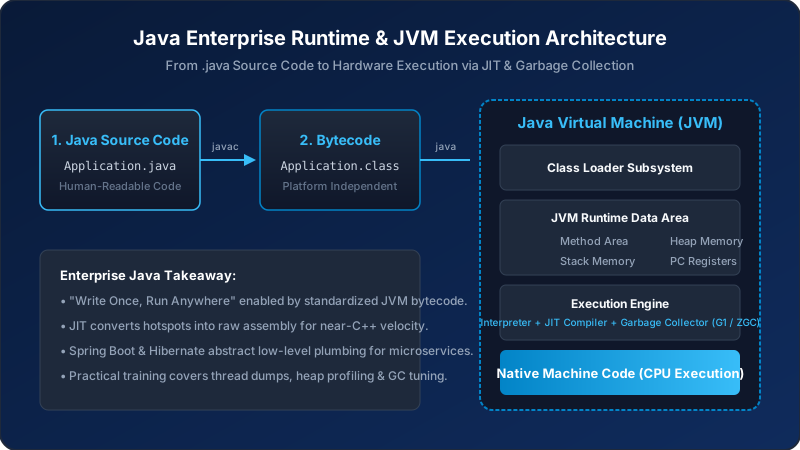
Why Learn This Technology?
Java consistently ranks among the top enterprise languages globally. Its type safety, robust memory management, backward compatibility, and mature ecosystem (Spring, Hibernate, Kafka) ensure sustainable, high-paying career trajectories for backend engineers.
Who Should Take This Course?
College graduates (B.Tech, BCA, MCA), self-taught programmers, and IT professionals transitioning to enterprise backend engineering.
Course Prerequisites
Basic understanding of computer logic or secondary school mathematics. No prior coding experience required.
Tools & Frameworks Covered
Career Opportunities & Outcomes
Graduates of this program are qualified for technical roles including:
- Java Software Engineer
- Backend Systems Developer
- Spring Boot Specialist
- Full Stack Java Developer
- Enterprise Application Consultant
Ghaziabad Training Center Location
Campus: C-60 R.K Tower, 3rd Floor, RDC, Ghaziabad
Inquiries: 7503962162
Get DirectionsComplete Course Syllabus
Structured modular learning path from foundational concepts to production-grade implementation.
Module 1: JVM Internals, Primitive Types & Control Structures
Weeks 1-3- ✓ JDK, JRE, and JVM Architectural Anatomy
- ✓ Bytecode compilation, ClassLoader hierarchy, and JIT compilation
- ✓ Primitive data types, IEEE-754 floating point nuances, and variable scoping
- ✓ Operators, bitwise manipulation, and precedence rules
- ✓ Control flow: switch expressions (Java 17/21), pattern matching, and loops
- ✓ Arrays in memory: 1D, multi-dimensional, and cache locality basics
Module 2: Object-Oriented Programming (OOP) & Memory Management
Weeks 4-6- ✓ Class structure, object instantiation, and constructor chaining
- ✓ Encapsulation: Access specifiers, record classes, and immutability patterns
- ✓ Inheritance: Method overriding, polymorphism, and virtual method tables
- ✓ Abstraction: Abstract classes vs. Sealed interfaces and default methods
- ✓ Memory lifecycle: Stack frames, Heap allocation (Young/Old gen), and Garbage Collection algorithms (G1, ZGC)
- ✓ Exception handling: Checked vs Unchecked exceptions, try-with-resources, and custom exceptions
Module 3: Java Collections Framework, Generics & Modern Streams
Weeks 7-9- ✓ Collection hierarchy: List (ArrayList vs LinkedList), Set (HashSet vs TreeSet), Queue
- ✓ Deep dive into Map: HashMap hashing, collision resolution (Red-Black tree rebalancing), ConcurrentHashMap
- ✓ Generics: Type erasure, bounded wildcards (? extends / ? super), and covariance
- ✓ Functional Programming: Lambdas, method references, and functional interfaces (Function, Predicate, Consumer, Supplier)
- ✓ Stream API: Intermediate (map, filter, flatMap) vs Terminal operations (collect, reduce, groupingBy)
- ✓ Modern features: Optional class best practices, text blocks, and pattern matching
Module 4: Concurrency, Multithreading & Virtual Threads
Weeks 10-11- ✓ Thread lifecycle, Runnable vs Callable, and Thread states
- ✓ Synchronization, intrinsic locks, race conditions, and deadlocks
- ✓ java.util.concurrent: ExecutorService, ThreadPoolExecutor, and Future/CompletableFuture
- ✓ Concurrent collections: CopyOnWriteArrayList, BlockingQueue
- ✓ Atomic variables and the Java Memory Model (volatile semantics)
- ✓ Project Loom: Virtual Threads (Java 21) and high-throughput I/O architectures
Module 5: Database Persistence with JDBC & Hibernate/JPA
Weeks 12-13- ✓ Relational database fundamentals and ACID properties
- ✓ JDBC API: DriverManager, PreparedStatement, ResultSet, and SQL injection prevention
- ✓ Connection Pooling: HikariCP configuration and performance metrics
- ✓ Object-Relational Mapping (ORM) fundamentals with Hibernate
- ✓ JPA entity mappings: @Entity, @Table, @Id, @GeneratedValue
- ✓ Relationships: @OneToOne, @OneToMany, @ManyToOne, @ManyToMany and FetchType (LAZY vs EAGER)
- ✓ JPQL, Criteria API, and resolving the N+1 query problem
Module 6: Spring Boot, REST APIs & Cloud Microservices
Weeks 14-16- ✓ Spring Core: Inversion of Control (IoC) and Dependency Injection (DI) mechanisms
- ✓ Spring Boot 3 auto-configuration, starter dependencies, and application.properties
- ✓ Building RESTful APIs: @RestController, @GetMapping, @PostMapping, and ResponseEntity
- ✓ Input validation with Jakarta Validation (@Valid, @NotNull, @Size)
- ✓ Global exception handling with @ControllerAdvice and ProblemDetails (RFC 7807)
- ✓ Spring Data JPA: JpaRepository, derived query methods, and pagination
- ✓ Containerization: Dockerizing Spring Boot apps and deploying to AWS/Linux environments
Real-World Enterprise Projects
You will write code for production scenarios, not just hello-world exercises:
Enterprise Multi-Tier E-Commerce Backend
A modular microservices system featuring catalog management, JWT authentication, cart persistence with Redis, order checkout with transactional boundaries, and PDF invoice generation.
High-Concurrency Banking Transaction Engine
Simulates high-throughput inter-bank transfers utilizing Virtual Threads, pessimistic locking against double-spending, and comprehensive audit logs.
Spring Cloud Distributed Telemetry Platform
Microservice mesh integrating Spring Cloud Gateway, Eureka Service Registry, OpenTelemetry tracing, and Grafana visualization.
Frequently Asked Questions
Do I need prior C or C++ knowledge before joining Java training?
Does this course cover modern Java versions like Java 17 and Java 21?
How much time is dedicated to hands-on coding vs lectures?
Visit Our Ghaziabad Training Center
Join classroom batches, attend interactive lab sessions, code with mentors, and take advantage of our high-speed dev workstations.
C-60 R.K Tower, 3rd Floor, RDC, Ghaziabad, Ghaziabad, Uttar Pradesh
Call 7503962162
Speak with a Course Mentor or Counselor
Receive syllabus details, batch timings, hands-on lab plans, and career roadmaps without sales pressure.